

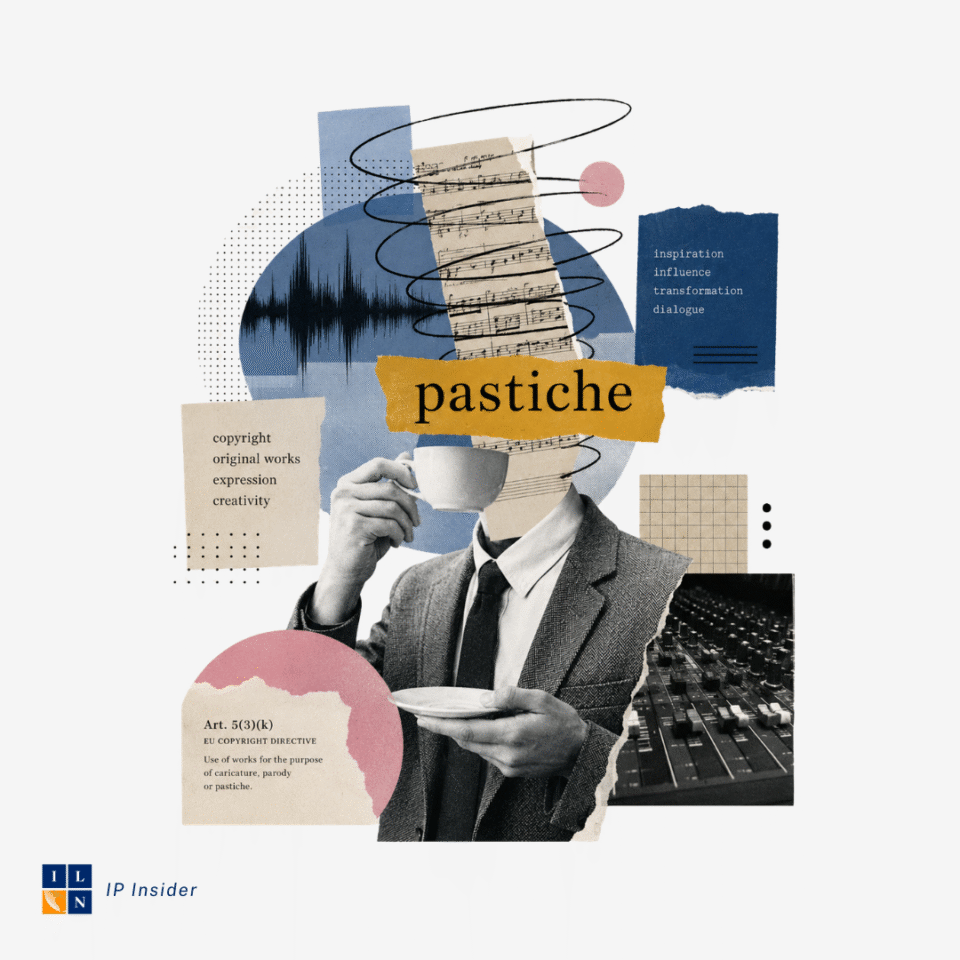
The EU Court’s Nifty Legal Kraftwerk In Finally Defining “Pastiche”:
…And What That Could Mean on Both Sides of the Atlantic & the Galaxy
By James P. Flynn, Epstein Becker Green
In the beginning (defined as 1977), there was a two-second rhythm loop. Kraftwerk, the Düsseldorf electronic music pioneers whose synthesizer-driven soundscapes helped define an era, laid down a percussion riff in their track Metall auf Metall that would prove as durable as the metal referenced in the track title (Listen to the drum sequence that begins roughly at the 0:03 – 0:05 mark of the 1977 album version). Twenty years later, hip-hop producer Moses Pelham lifted that two-second loop, modified it ever so slightly, and played it as a continuous backbone beneath Sabrina Setlur’s 1997 rap track Nur mir. And with that, one of the longest-running copyright disputes in the history of intellectual property law was launched, a sort of legal Metall auf Metall loop of its own that has been repeating, with variations, ever since.
On April 14, 2026, after a journey through the German courts that would have exhausted the patience of a Stoic philosopher, the Grand Chamber of the Court of Justice of the European Union (CJEU) issued its long-awaited ruling in CG and YN v. Pelham GmbH and Others, Case C-590/23 (Pelham II). This is the second time this same fact pattern, featuring the same two-second sample, had arrived at the CJEU’s Luxembourg doorstep. The first visit, in Pelham I (Case C-476/17, decided July 29, 2019), had established that sampling requires permission unless the sample is acoustically unrecognizable. Now, in Pelham II, the Court was asked to define “pastiche,” one of the most enigmatic concepts in all of (European) copyright law.
The answer the Court gave is that pastiche requires a recognizable “artistic or creative dialogue” with the borrowed work, but need not be humorous, satirical, or even expressly intended as such. That standard is worth pausing over. Not only does it matter enormously to the music industry, to digital creators, to remix culture, and to every EU Member State that has recently been required to implement the pastiche exception, but it also invites a transatlantic comparison with how American copyright law handles the closely-related question of what kinds of homage, tribute, and creative borrowing deserve protection. And on that comparison, as this author wrote here in 2017 when musing about the Paramount Pictures Corp. v. Axanar Productions, Inc. litigation, the two systems reach strikingly different destinations, even if they start from a roughly similar point.
The Odyssey: From Hamburg to Karlsruhe to Luxembourg, and Back Again
To appreciate the significance of Pelham II, it helps to understand the procedural marathon that produced it, as described by several industry followers. The case traveled, in no particular hurry, through the Hamburg Regional Court (which sided with Kraftwerk in 2004), the Hamburg Higher Regional Court (which dismissed Pelham’s appeal in 2006), Germany’s Federal Court of Justice or Bundesgerichtshof (the BGH, which sent the case back down in 2008), back to the Hamburg Higher Regional Court (which ruled against Pelham again in 2011), back to the BGH (which again dismissed Pelham in 2012), then up to Germany’s Federal Constitutional Court, the Bundesverfassungsgericht, which upended earlier rulings in 2016 on constitutional freedom-of-the-arts grounds, back to the BGH for a third time (which made the first referral to the CJEU in 2017), to Luxembourg for Pelham I in 2019, back to the BGH again in 2020, down once more to the Hamburg Higher Regional Court (which ruled in Pelham’s favor on the pastiche issue in April 2022), and then, inevitably, back to the BGH for a fourth bite at the apple, which finally referred the pastiche question to Luxembourg in September 2023. If this were a vinyl record, it would have been played to scratches long ago from going round after round.
The key turning point in that last phase was Germany’s 2021 enactment of §51a of the Urheberrechtsgesetz (UrhG), which Pelham II later translates as saying at para. 7 that “The reproduction, distribution and communication to the public of a published work shall be authorised for the purpose of caricature, parody or pastiche. The authorisation referred to in the first sentence shall cover the use of an image or other reproduction of the work used, even if that image or other reproduction is itself protected by copyright or a related right.” That law responded to both the CJEU’s Pelham I ruling and obligations under Article 17(7) of the EU’s Digital Single Market Directive. Under that law, one could, for the first time, reproduce works expressly “for the purpose of caricature, parody or pastiche.” The Hamburg Higher Regional Court, on remand, found that Pelham’s sampling after June 7, 2021 was covered as “pastiche” and therefore non-infringing. Kraftwerk’s successors appealed. The BGH, uncertain what “pastiche” actually meant, referred two precise questions to the CJEU, as recounted at Pelham II, paras. 27 and 30:
(1) whether the rule defining the limitations of copyright and related rights as regards the use of a work or other subject matter for the purpose of pastiche, within the meaning of Article 5(3)(k) of Directive 2001/29, has a catch-all nature (Auffangtatbestand) that covers in any event artistic engagement with an existing work or other object of reference, including in the form of sampling, or whether the concept of ‘pastiche’ is subject to restrictive criteria such as a requirement of humour, stylistic imitation or tribute[?]
(2) whether a finding that a work or other subject matter protected by copyright is used ‘for the purpose’ of pastiche presupposes an intention on the part of the user to use that protected work or subject matter for that purpose[?]
The CJEU’s Grand Chamber answered both questions with what might be called a calibrated “no.” Pelham II at para. 32-58 and 59-62. Pastiche is not a catch-all for any kind of borrowing, but neither does it require humor, explicit tribute, or stylistic mimicry in the narrow sense. And intent is not required; but recognizability is.
Defining “Pastiche” and Avoiding Both the Vacuum and the Vortex
Let’s pause here to note a small linguistic fact. “Pastiche,” as this author observed when answering his own rhetorical “So what is pastiche?” question back in 2017, is actually a French cognate of the Italian noun pasticcio. That word describes a pâté or pie-filling assembled from varied ingredients. Like a well-made pasticcio, the legal concept has always contained more ingredients than any single recipe might suggest, and the CJEU proved well aware of this.
The Pelham II Court began its definitional work by rejecting the tempting simplicity of a catch-all reading. If “pastiche” swallowed all forms of artistic borrowing, it would render the neighboring concepts of “parody” and “caricature” in Article 5(3)(k) of the InfoSoc Directive entirely redundant, which is a classic interpretive sin under EU (and indeed, often, US) law. The legislative redundancy problem cuts both ways, however: if pastiche were simply a synonym for parody (requiring, as parody does since Deckmyn v. Vandersteen, Case C-201/13, some element of mockery or humor), there would be no point having the word at all.
Instead, the Pelham II Court settled on a purposeful middle path. Acknowledging that the term “pastiche” is “rarely used in everyday language” but is “commonly used to designate a creation in a style which imitates that of another work, artist or works belonging to the same artistic movement,” the Grand Chamber in Pelham II (in Ruling, para.1 at page 15), defined pastiche as:
“[C]reations which evoke one or more existing works, while being noticeably different from them, and which use, including by means of sampling, some of those works’ characteristic elements protected by copyright, in order to engage with those works in an artistic or creative dialogue that is recognisable as such and that can take different forms, in particular the form of an overt stylistic imitation of those works, of a tribute to them or of humorous or critical engagement with them.”
Three elements are worth isolating in that definition:
- first, the new work must evoke the original while being noticeably different from it, a requirement of both connection and distinction, not unlike the conundrums we saw (and discussed) in Andy Warhol Foundation for the Visual Arts, Inc. v. Goldsmith, 143 S. Ct. 1258 (2023);
- second, it must use characteristic copyright-protected elements of the original; and
- third, it must engage with the original in an “artistic or creative dialogue that is recognisable as such.”
This last dialogue test is where the rubber meets the road. Forms that qualify include tribute, stylistic imitation, and humorous or critical engagement. But the Court was careful not to make any single form a prerequisite. The dialogue simply has to be there, and it has to be recognizable.
On the second question (whether intent is necessary?), the Court held that no, it is not. The proper test is objective: whether “a person familiar with the existing work from which the elements have been borrowed” would recognize the use as pastiche. This is a significant practical point for artists and producers. It means that a creator who borrows characteristic elements and engages in a recognizable dialogue with an original work does not lose the protection of the pastiche exception merely because she did not have the label “pastiche” affixed in her mind when she created the new work. The law evaluates the result, not the creator’s mental taxonomy.
The Court also devoted considerable attention to the balancing framework, noting that the pastiche exception must be applied consistently with the three-step test in Article 5(5) of the InfoSoc Directive. It applies only in “certain special cases” that do not unreasonably prejudice the rightholder. This is not a free pass for wholesale appropriation. The “noticeably different” requirement, the “recognisable dialogue” standard, and the three-step filter together mean that a sampler cannot simply loop any segment of someone else’s phonogram, call it a dialogue, and walk away free.
Scotty, Beam Us Over to the Other Side of the Atlantic
In January 2017, this author presented a thought experiment about the Star-Trek-fan-fiction-inspired Axanar litigation: what if the defendant fan-filmmakers who created a faithful, reverential, deeply researched prequel to the original Star Trek series had been able to invoke a “pastiche” fair dealing defense (as might have been available in the UK or under the EU’s InfoSoc Directive) rather than being stuck with the narrower American parody-based fair use analysis? The answer, this author suggested, was that they might have fared considerably better.
That thought experiment has, with the Grand Chamber’s April 2026 ruling, become considerably more concrete.
American copyright law protects parody as fair use under 17 U.S.C. § 107, but the key requirement, as the Supreme Court established in Campbell v. Acuff-Rose Music, Inc., 510 U.S. 569 (1994), is that the parody must target the original work. In other words, it must criticize or comment upon the work it borrows. But what does one do with a loving tribute, a faithful homage, or a reverential imitation? These do not qualify. As the Second Circuit held in Castle Rock Entertainment v. Carol Publishing Group, 150 F.3d 132, 145 (2d Cir. 1998), if a work “pays homage” to the original rather than critiquing it, it cannot qualify as parody. The Sixth Circuit agreed in Bridgeport Music, Inc. v. UMG Recordings, Inc., 585 F.3d 267 (6th Cir. 2009), holding that a jury instruction stating that “an homage or tribute” is not fair use accurately states the law.
The Axanar case demonstrated this principle with particular clarity. Alec Peters and the Axanar team had set out to create a faithful, independent Star Trek film using the copyrighted source material “as a bible.”(at page 7). They stayed true to Star Trek canon “down to excruciating details.” (at page 7). The court found that “Star Trek fans love Defendants’ faithfulness to the Star Trek canon,” (at page 7) and that statement of fan approval effectively sealed their fate under U.S. copyright law. The more faithful the homage, the less it criticizes, and the less it criticizes, the less it can qualify as parody. Faithfulness, in the American framework, is its own undoing.
Now consider how the same set of facts might be analyzed under the CJEU’s pastiche framework from Pelham II. The Axanar Works clearly evoke the original Star Trek universe while being noticeably different from it. They are new films, with new scripts, new performances, and (at least in the prequel premise) a new narrative. They use characteristic, copyright-protected elements of the Star Trek works, like Klingons, Vulcans, the character Garth of Izar, starship designs, the visual language of the universe Gene Roddenberry built. And, critically, they engage in an artistic dialogue with the original works that is recognizable as such, not only to a person familiar with the original works, but to virtually every viewer. The dialogue is, if anything, louder and more explicit than in most pastiches (and certainly more express than anything lasting only two seconds): the Axanar creators expressly identified themselves as working within, and paying tribute to, the creative universe they had grown up loving.
Under the CJEU’s new framework, such a recognizable, reverential, differentiating creative dialogue would seem to fall within the definition of “pastiche.” The works evoke; they are noticeably different; they engage dialogically in a manner a familiar audience would recognize. That they do so reverentially rather than mockingly would be, under Pelham II, beside the point. The Pelham II Court expressly includes “tribute” as a qualifying form of the creative dialogue.
In the American universe, that tribute was the fatal flaw. In the European one articulated by the Grand Chamber, it may be the qualifying feature. As Mr. Spock might observe, the logic of the two systems is internally consistent, but their premises diverge at a foundational level.
The Pastiche That Dare Not Speak Its Name …Until Now
One of the features of the Pelham II ruling that deserves particular attention is the Court’s treatment of what we might call the “vocabulary problem.” As the 2017 Axanar article noted, a Lexis search of American federal cases at that time found precisely one decision that mentioned both the word “pastiche” and the phrase “fair use,” Disney Enters. v. Hotfile Corp., decided by the S.D. Fla. in 2013, and there the word referred to an assortment of collected evidence rather than a legal defense. Repeating that search today, we find only more case, Graham v. Prince, a 2023 SDNY decision that uses both terms in the fair use analysis:
Defendant Richard Prince is a well-known contemporary appropriation artist. Appropriation art, as one expert describes it, involves a “radical transformation of the original image or text” using strategies such as aesthetic alteration, conversion of authorship, recontextualization, cultural commentary, and pastiche or parody.
***
In both lawsuits, defendants filed motions to dismiss asserting the defense of fair use. On July 18, 2017, this Court denied defendants’ motion to dismiss in Graham, finding that “this is not a case in which the open-ended and context-sensitive fair use inquiry can be properly applied at the motion to dismiss stage.” Graham v. Prince, 265 F. Supp. 3d 366, 379 (S.D.N.Y. 2017). The Court concluded that not one of the four fair use factors favored defendants. Id. at 380. With an eye towards the inevitable summary judgment motions, the Court reviewed the case law and suggested that specific evidence, such as the opinions of art critics and collectors, could aid the Court’s summary judgment analysis. See id. at 382, 385.
Though “fair use” was referenced in the Graham opinion 75 more times beyond the three references in the above quote, “pastiche” was mentioned only that once. Those two fleeting refences in separate cases and contexts hardly give “pastiche” a solid foundation in American fair use jurisprudence. The statute does not use it. The courts have not developed it. The word, for U.S. copyright purposes, might as well be Klingon.
In Europe, by contrast, the concept is now legislatively embedded and judicially defined. Article 5(3)(k) of the InfoSoc Directive has always listed “caricature, parody or pastiche” as optional exceptions, and the DSM Directive made the trio mandatory for user-generated content on content-sharing platforms under its Article 17(7). EU Member States have had to grapple with the concept. Germany enacted §51a UrhG in 2021. The UK embedded it in Section 30A of the Copyright, Designs and Patents Act 1988 before Brexit removed it from the EU legal framework but not from the statute books.
What the Pelham II Court has now provided is the first authoritative EU-level definition of the term. Prior to Pelham II, commentators noted that “pastiche” had been interpreted differently in different Member State courts and legal traditions, narrowly in some, expansively in others. The Advocate General Szpunar’s Opinion in Pelham I in 2018 had flagged (at para. 70) the concept as potentially applicable to sampling while expressing reservations, and Advocate General Emiliou’s Opinion of June 2025 in Pelham II had pushed the Court (at paras. 81-91, 133) toward the definition it ultimately adopted, while also making the provocative suggestion that the InfoSoc Directive as a whole was too restrictive in the area of artistic reuse to be compatible with the EU Charter’s guarantee of freedom of the arts.
The Pelham II Court’s judgment did not go quite that far. But it built the definition firmly around the fundamental rights framework, balancing copyright protection against artistic freedom in a manner that U.S. law does not formally undertake in its fair use calculus. As one market participant and commentator noted, “The European Court of Justice has helped to clarify the urgently needed definition of the concept of pastiche, thereby seeking to strike a balance between artistic freedom and the protection of intellectual property, …This is also significant because the exception introduced in Germany in 2021 has so far been associated with considerable legal uncertainty.”
It is also worth noting what the Pelham II Court’s definition does not require. It does not require that the new work itself constitute an “original” copyright-protected work (That view endorsed by the European Copyright Society in its own amicus-style opinion filed in connection with Pelham II). It does not require that the engagement with the original be overt, annotated, or explicitly acknowledged. It does not require any particular artistic ambition or cultural prestige. A loop of two seconds, embedded in a hip-hop track, can qualify as long as the dialogue is there and it is recognizable to the right audience.
The Recognizability Requirement And Its Limits
The “recognisable as such” requirement is the Pelham II Court’s most important limiting principle, and it deserves careful examination. It is not enough that someone might perceive a creative dialogue with the original; the recognizability must attach to “a person familiar with the existing work.” This is an objective standard calibrated to the relevant audience, whether that be the community of listeners, viewers, or readers who know both the source and the borrowing.
This audience-specific standard will generate interesting questions in practice. Consider the Metall auf Metall loop at the center of Pelham II itself. Kraftwerk’s music, though globally influential, is not universally known, and guessing the song on only two seconds seems like some bizarre revenge fantasy from the classic Bid-A-Note segment of Name That Tune. Would a mainstream listener of early-1990s German rap recognize the Kraftwerk (two-second) loop in Nur mir? Perhaps not. But, so the argument goes, a person familiar with the Kraftwerk source material would recognize it. That, says the Court, is sufficient. This is consistent with how the Court had approached “parody” in Deckmyn: the test is whether a parodic character “may reasonably be perceived,” not whether every listener perceives it. (I remain skeptical that the two second loop, even if repeated, could really be a “dialogue” between the works allowing for such perception, but who am I to judge?).
The recognizability requirement also connects in an interesting way to the “noticeably different” requirement. For a use to qualify as pastiche, the new work must both evoke and differ from the original. This dual demand creates a sort of creative tension in that the new work must be distinct enough to stand apart, but connected enough for the dialogue to be apparent. A sampling that so thoroughly transforms the original that no trace remains is already covered by Pelham I‘s “unrecognizable to the ear” safe harbor, such that there is no infringement there in the first place. The pastiche exception, by contrast, covers samples that are recognizable, but that are used in a recognizably dialogic way in the new work. It is, in other words, the zone of recognizable-but-differentiated borrowing that the exception is designed to occupy.
The Axanar works would seemingly easily satisfy the recognizability test. Every element borrowed from the Star Trek canon (from the Klingon characters, to the Starfleet setting, to the Garth of Izar storyline, to the visual design language) was not merely familiar to the target audience; it was the raison d’être of the films. These works were made for Star Trek fans to recognize precisely those borrowed elements. The challenge, under European law, would not be whether the dialogue is recognizable (it manifestly is) but whether the resulting work is “noticeably different” from the original and whether the engagement constitutes the kind of “artistic or creative dialogue” the Court envisioned.
On both counts, the argument for the Axanar works seems more plausible under European law than it ever was under U.S. law’s parody rubric. These are not, after all, mere copies of Star Trek episodes. They are new stories, told in a new register, occupying a different narrative. They are a prequel that expands the universe rather than reproducing it. The tribute and the transformation coexist.
The System Question And the Mirror, Mirror Moment
There is a deeper structural question lurking behind the comparison between Pelham II and the American approach. In the United States, the fair use defense under 17 U.S.C. § 107 is famously open-textured, with four factors, none dispositive, all weighed in light of the ultimate question of whether the use serves or harms copyright’s underlying purposes. The system is flexible but unpredictable; it produces different results in different circuits, and its treatment of transformative use has shifted considerably since Campbell. The Supreme Court’s recent intervention in Andy Warhol Foundation for the Visual Arts, Inc. v. Goldsmith, 143 S. Ct. 1258 (2023), has recalibrated the transformativeness analysis in ways that arguably narrow fair use for commercial uses even of genuinely new creative work.
The European system, by contrast, operates with a closed list of permitted exceptions. Article 5 of the InfoSoc Directive is exhaustive and Member States cannot add new exceptions beyond what the Directive provides. That rigidity is both a strength and a weakness. On one hand, it provides certainty: if your use fits within one of the listed exceptions, you are protected. On the other hand, it means that creative uses not anticipated by the list have no safe harbor, no matter how beneficial to the public interest. The pastiche exception was in an historically underdeveloped state; the Axanar article noted in 2017 that it had almost no case law anywhere in Europe. This meant that an entire category of legitimate creative borrowing was essentially unprotected in practical terms until courts began defining the term.
The Pelham II Grand Chamber has now, supposedly, filled that gap, and done so in a manner that is, at least in the Court’s own view, calibrated to balance copyright protection against the EU Charter’s guarantee of freedom of the arts. Advocate General Emiliou had gone further, suggesting that the InfoSoc Directive itself may be constitutionally infirm in its failure to accommodate sufficiently the artistic uses of protected material.
For American practitioners watching this development, the parallel is the ongoing debate over whether the fair use framework that has developed case by case over decades has reached its limits as a mechanism for protecting genuinely transformative and creative uses of copyrighted works. The Warhol decision’s narrowing of transformativeness for commercial purposes has already produced commentary calling for legislative attention. And Pelham II‘s pastiche framework protects tribute and dialogue even in commercial creative contexts. But that represents a different choice, made by a different legal system, that deserves serious attention in that debate.
There is a moment in the original Star Trek series episode “Mirror, Mirror” when Captain Kirk finds himself transported to a parallel universe where the Federation is an empire and every familiar character has a darker counterpart. The moment of recognition involves knowing the face but finding a different soul behind it. That is precisely what the CJEU’s pastiche definition is designed to protect: the creative work that is recognizably connected to an original, yet noticeably, meaningfully different. In the US universe, Axanar could not prevail in federal court in California. In the European parallel universe, it might have won. That is not merely a hypothetical of academic interest. It tells us something important about the values embedded in copyright law on each side of the Atlantic, and about the choices each system has made in balancing the rights of creators and the interests of the creative public.
The Loop Keeps Playing
The Metall auf Metall loop that Moses Pelham borrowed in 1997 was two seconds long. The litigation it spawned has now consumed nearly three decades, twelve judicial opinions in Germany, two CJEU Grand Chamber judgments, and the professional attention of enough intellectual property lawyers to fill a small conservatory. The case will now return, yet again, to the BGH, which will apply the CJEU’s definition of pastiche to the specific facts and determine whether Nur mir qualifies.
What the Court has given us in Pelham II is a definition of pastiche that is neither a free pass nor a dead letter. It requires real creative dialogue that is recognizable, differentiated and dialogic. It protects tribute, stylistic imitation, and creative homage alongside more critical or humorous forms. It evaluates the result objectively rather than searching for the creator’s subjective intention. And it does all of this in explicit service of a balance between copyright protection and the freedom of the arts that the EU Charter demands.
That is a richer toolkit than the American parody defense offers, and it points toward a different and seemingly more creatively generous set of answers to the recurring question of when borrowing becomes infringement and when it becomes art. The Axanar crews and the independent filmmakers (and the hip-hop producers and the meme-makers and the remix artists) of the world would do well to follow the next chapter in the Metall auf Metall saga, as the BGH applies Pelham II‘s framework to the facts that started the whole loop playing.
As for Kraftwerk and Pelham, they may yet have one more rendezvous in Hamburg. The loop, it seems, is still playing, but the legal backdrop has changed. “If change is inevitable, predictable, beneficial, doesn’t logic demand that you be a part of it?” As Mr. Spock suggests implicitly in “Mirror, Mirror” and many other places in the original series expressly such as “Space Seed,” it is not logical to remain static in the face new evidence because “[i]nsufficient facts always invite danger.” And Pelham II is, at a minimum, very new evidence indeed.
Lawyers within the ILN Intellectual Property Specialty Group regularly advise clients on protecting and managing intellectual property rights across jurisdictions. Learn more about our global IP capabilities.
Related ILN Insights (Intellectual Property):
- The 99 Year Dilution Dilemma: What’s the Harm if No Confusion?
- Katy v Katie: The Case That Got Away
- Strategic intellectual property considerations for artificial intelligence technologies: How “non-tech” companies could be missing hidden IP goldmines
As cross-border trade in art, media, and creative works continues to grow, legal frameworks like this are increasingly relevant for clients operating internationally.
If you have questions about cross-border intellectual property matters, ILN firms are available to assist across jurisdictions.


