
Find a firm
Search International Lawyers Network Members

Creative Expression, Feuds, & Cross Words Across Borders
By James P. Flynn, Epstein Becker Green
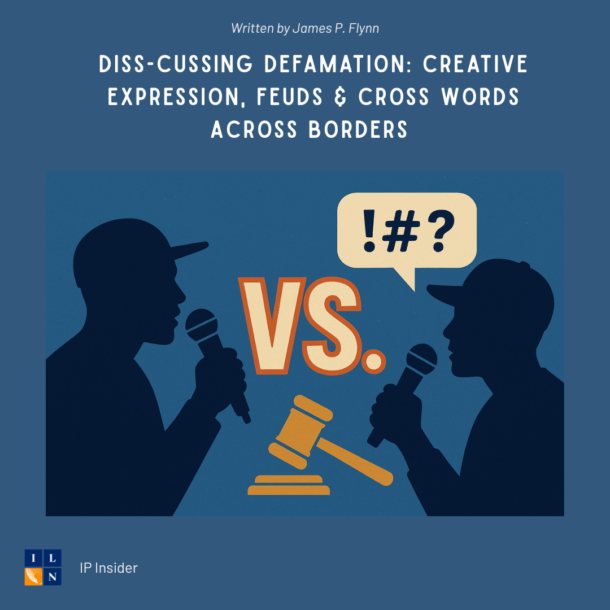
The legal intersection of music, poetry, and defamation presents a fascinating landscape where creativity collides with reputational interests. The recent decision in Graham v. UMG Recordings, Inc.—filed by Canadian rapper Aubrey “Drake” Graham over the diss track Not Like Us by Kendrick Lamar, a rapper who grew up in Compton, California—offers a contemporary lens on this tension. Yet, the legal questions it raises resonate globally, from India to the United Kingdom to the US, illustrating both the universality and jurisdiction-specific nuances of evaluating artistic speech in the defamation context.
What is a diss track?
My sense is that many of us have heard this term, and probably have heard specifically about the diss tracks in this feud between Drake and Kendrick Lamar. Indeed, some of us are old enough to remember the earlier, more innocent times when Carly Simon’s You’re So Vain was considered a diss track of sorts, albeit with targets of disparagement that were a bit more ambiguous. But, in short, as one resource summarizes it, the definition of such a track is:
A diss track, diss record or diss song (an abbreviation of disrespect or disparage) is a track that verbally attacks someone, usually another artist. Diss tracks are often the result of an existing, escalating feud between the two people; for example, the artists involved may be former members of a group, or artists on rival labels.
The diss track as a medium of its own was popularized within the hip-hop genre, fueled by the hip-hop rivalry phenomenon (especially the East Coast–West Coast hip-hop rivalry of the mid-1990s). More recently, entertainers from outside the traditional music landscape have adopted the genre. […] Though the term “diss track” originated in hip-hop, there are many examples throughout music history of earlier songs written as attacks on specific individuals. Some have also been retroactively described as diss tracks in their own right.
That same resource, and others, take that history of diss tracks, at least in the US, from the present rap era all the way back to Yankee Doodle Dandy, a song “already well known by the 1750s” and “that in 1755 [was one for which] a British doctor named Richard Schuckburg penned new words to mock his American allies,” making it a proverbial “Colonial Insult.” See Yankee Doodle: The story behind the song. Outside of the U.S., some would take such rap music back to the trouble songs of the medieval troubadours and the mocking songs (Cantigas de escárnio e maldizer) that M. Ana de Guzmán has described as among the “The Disses and Rap Battles of the 13th Century Iberian Peninsula.” This world history goes still further back to Five Ancient Forms of Diss Track, reaching all the way through the English and Scottish flyting (“a form of highly poetic abuse”) of the Dark and Middle Ages to Anglo-Saxon bēots to Greek and Latin insult poetry and even earlier to the traded barbs among Mesopotamian scribes in training in ancient Sumer, who were among “[s]ome of the first people to write stuff down.”
Though all of great interest, we leave these extended histories to your independent reading pleasure as we fast forward to today:
Graham v. UMG: A U.S. Perspective
Drake, a leading figure in the music industry, has been associated with Universal Music Group for over 20 years. UMG provides artists like Drake with the necessary tools and platforms to produce, market, and sell their music. The company, via its subsidiary Universal Music Publishing Group, exclusively controls the rights to publish and distribute the works of Drake and Kendrick Lamar.
Lamar and Drake entered into a “feud,” going back and forth through “diss tracks.”
On April 19, 2024, Drake released a diss track directed at Kendrick Lamar called Push Ups. In Push Ups, Drake’s lyrics mock Lamar’s height and shoe size, (“How the f*** you big steppin’ with a size-seven men’s on/. . . Pipsqueak, pipe down”), and questions Lamar’s success, id. (“You ain’t in no big three/. . . I’m at the top of the mountain, so you tight now/Just to have this talk with your a**, I had to hike down.”). A few days later, Drake released Taylor Made Freestyle, in which he used artificial intelligence-generated voices of deceased rapper 2Pac and of rapper Snoop Dogg to goad Lamar. In the track, “2Pac” and “Snoop Dogg” share their disappointment that Lamar had not yet responded to “Push Ups.” (“Kendrick, we need ya, the West Coast savior/. . . You seem a little nervous about all the publicity/. . . you gotta show this f***in’ owl who’s boss on the West.”). Drake, in his own voice, further taunts Kendrick for failing to come up with a satisfactory response, saying, “I know you’re in that NY apartment, you strugglin’ right now, I know it/In the notepad doing lyrical gymnastics, my boy.” Drake also surmises that Kendrick was purposefully delaying his response because artist Taylor Swift had just released a new album. (“[S]hout out to Taylor Swift/Biggest gangster in the music game right now/. . . She got the whole pgLang on mute like that Beyoncé challenge, y’all boys quiet for the weekend.”).
Lamar responded to Drake in Euphoria, which was released on April 30, 2024. In the track, Lamar claims, “I make music that electrify ‘em, you make music that pacify ‘em” and that he would “spare [Drake] this time, that’s random acts of kindness.” He accuses Drake of lying: “Know you a master manipulator and habitual liar too/But don’t tell no lie about me and I won’t tell truths ‘bout you.” He insults Drake’s fashion sense (“I hate the way that you walk, the way that you talk, I hate the way that you dress”), further raps “I believe you don’t like women, it’s real competition, you might pop a** with ‘em,” and taunts Drake for being a coward with his responses (“I hate the way that you sneak diss, if I catch flight, it’s gon’ be direct.”).
On May 3, 2024, the feud between Drake and Lamar escalated again, as they increased the personal accusations at each other over the course of the day. First, Lamar released 6:16 in LA, in which he calls Drake a “terrible person” and accuses Drake of “playin’ dirty with propaganda.” Drake’s next response arrived later that day in Family Matters. Drake jabs at Lamar’s relationship with his partner (“You the Black messiah wifin’ up a mixed queen/And hit vanilla cream to help out with your self-esteem/On some Bobby sh**, I wanna know what Whitney need”) and implies that Lamar physically abused her, (“Your baby mama captions always screamin’, ‘Save me’/You did her dirty all your life, you tryna make peace.”). Moreover, Drake calls into question whether Lamar is the biological father of one of his children. (“I heard that one of ‘em little kids might be Dave Free/Don’t make it Dave Free’s”). Almost immediately after the release of “Family Matters,” Lamar unleashed the scathing Meet the Grahams, in which he accuses Drake of being a “deadbeat” father and of hiding the existence of other children. (“You lied about your son, you lied about your daughter, huh/You lied about them other kids that’s out there hopin’ that you come.”). Lamar also alleges that Drake has “gamblin’ problems, drinkin’ problems, pill-poppin’ and spendin’ problems/Bad with money, wh***house/Solicitin’ women problems, therapy’s a lovely start.” He further insinuates that Drake was a “predator” and that Drake “should die so all of these women can live with a purpose.”
The next day, on May 4, 2024, Lamar released Not Like Us. Not Like Us explicitly names Drake and his associates as pedophiles. Id. Specifically, the track contains the following lyrics:
Say, Drake, I hear you like ‘em young
You better not ever go to cell block one
To any b**** that talk to him and they in love
Just make sure you hide your lil’ sister from him…
Certified Lover Boy? Certified pedophiles…
Why you trollin’ like a b****? Ain’t you tired?
Tryna strike a chord and it’s probably A-Minor
On May 5, 2024, Drake responded in The Heart Part 6, directly denying Lamar’s allegations of pedophilia (“I never been with no one underage, …/If I was f***ing young girls, I promise I’d have been arrested/I’m way too famous for this s*** you just suggested/. . . Drake is not a name that you gon’ see on no sex offender list.”). In the track, Drake further sneers that “[t]his Epstein angle was the s*** I expected” and accused Lamar of wanting to “misdirect.” Drake also alleges that he had planted some of the information Lamar has used against him. (“We plotted for a week, and then we fed you the information/. . . But you so thirsty, you not concerned with investigation/. . . You gotta learn to fact-check things and be less impatient.”).
It is important to note that Drake may have later moved to the legal forum since Not Like Us appeared to be a commercial knockout punch (which “broke the record for most single-day Spotify streams for a hip-hop song in the US,” as one source noted) in the rap feud that the Heart Part 6 (which didn’t come close to as many views) just didn’t match up against:
Not Like Us, which was released in May 2024, was widely seen as the decisive blow in an ongoing battle between the rival rappers.
It has become the biggest hit of Lamar’s career, having won five Grammys and being one of the most-talked about moments of his Super Bowl half-time show in February.
[Saad & Savage, Drake’s lawsuit over Kendrick Lamar diss track is dismissed, BBC]
In sum, Drake filed suit alleging that Lamar’s lyrics defamed him by falsely suggesting criminal sexual misconduct, and that UMG amplified this harm through promotional activities. Drake’s lawsuit, filed in January 2025, accused UMG of defamation, harassment, and deceptive business practices under New York law. He contended that the lyrics of Not Like Us, which included phrases such as “certified pedophile” and “neighborhood watch,” were false and defamatory. Drake further alleged that UMG had promoted the song through deceptive means, including artificial inflation of its popularity, thereby amplifying the reputational damage.
Unfortunately, Drake suffered a similar knockout blow in court. Judge Jeannette A. Vargas dismissed the lawsuit, holding that the lyrics constituted nonactionable opinion rather than statements of fact. The court emphasized the context of a rap feud, where hyperbolic and exaggerated language is expected, concluding that no reasonable listener would interpret the lyrics as literal assertions of fact.
The Graham opinion emphasized several key points:
The Graham court relied on precedent protecting expressive, rhetorical statements in public disputes, reinforcing the principle that artistic hyperbole enjoys robust First Amendment protection. Importantly, the ruling was procedural: a 12(b)(6) dismissal assessing the plausibility of a claim, not the ultimate truth or falsity of any factual allegation.
Comparative U.S. Cases
Graham’s reasoning fits among other, earlier U.S. cases addressing songs and poems:
Each of these earlier U.S. cases suggested the outcome seen in Graham.
An International Comparison: India
On previous occasions, we have drawn lessons from, or followed developments in, India to illustrate how these issues play out beyond U.S. borders. We did it in a piece concerning deep fakes and elections, and in another concerning satire and humor as defenses to legal claims (where we cited the Indian High Court at Delhi in Tata Sons Limited vs Greenpeace International & Anr on 28 January 2011 (para. 24, 41-43)). We also did it when discussing copyrighting functional objects, and extensively when discussing whether one can acquire individual intellectual property rights in holy names, sacred words, and other aspects of creation. Probably did it on other topics as well, but these examples suffice to illustrate the many ways that a comparative law analysis can deepen our understanding, wherever we sit.
Now we look to India in this piece concerning whether non-copyright legal liability can arise from a poem or song.
The Indian Supreme Court has confronted analogous tensions in the Judgment in Imran Pratapgarhi, Criminal Appeal No.1545 of 2025, where a Congress MP and poet shared a poem with an accompanying video-ed song clip.
Complaints led to a First Information Report (or FIR) being filed alleging public order offences. Essentially, somebody filed charges at Jamnagar Police Station for the offences punishable under Sections 196, 197(1), 302, 299, 57 and 3(5) of the Bharatiya Nyaya Sanhita, 2023 (for short, ‘the BNS’), alleging that the posted video of a recited poem incited disorder because “the spoken words of the poem incite people of one community against another, and it hurts a community’s religious and social sentiments. It is alleged that the song had lyrics that incited people of other communities to fight for the community’s rights. It is alleged that the video posted by the appellant created enmity between two communities at the national level and hatred towards each other. It was further alleged that it had a detrimental effect on national unity.” Pratapgarhi Judgment at 3. According to the charging party, the video-ed poetry reading posted on X was one “using provocative language about the religion, caste and language of Hindus, Muslims and other castes living in India, promoting enmity between different groups, making statements that are detrimental to national unity, making statements that are harmful to national unity, making statements with the intention of hurting religious feelings, making religious insults, spreading the video among the people with the intention of causing shock, inciting others to commit a crime.” Pratapgarhi Judgment at 9.
The charged party claimed that the recited verse did nothing of the sort, but that on “a plain reading of the song poem, it is a message of love and non-violence….[I]t is about sacrificing oneself to fight for rights and truth. The poem promotes non-violence and preaches that one must suffer injustice with love.” Pratapgarhi Judgment at 4-5. As the Court noted, of the poem that had been recited in Urdu, that:
A broad English translation of the said poem reads thus:
“Those who are blood thirsty, listen to us
If the fight for our rights is met with injustice
We will meet that injustice with love
If the drops flowing from a candle are like a flame (Analogy: if the tears from our face are like a flame)
We will use it to light up all paths
If the bodies of our loved ones are a threat to your throne
We swear by God that we will bury our loved ones happily
Those who are blood thirsty, listen to us.”
[Pratapgarhi Judgment at 6-7]
The Indian Court agreed with the charged party’s reading, and so ruled in a March 28, 2025 opinion. Pratapgarhi Judgment at 7-8.
Indeed, on that basis, the Court quashed the FIR, emphasizing the constitutional protection of artistic and related expression. In fact, those protections are so strong that, according to the Indian Court, even though such protected expressions are marked by “[s]ome extravagance of language” and “the usual crude emotional appeal which is the stock and trade of the demagogue, as well as a blundering and ineffective attempt to ape the poets.” Pratapgarhi Judgment at 32. Because “[l]iterature including poetry, dramas, films, stage shows, satire and art, make the life of human beings more meaningful,” Pratapgarhi Judgment at 43, “Courts, particularly the constitutional Courts, must be at the forefront to zealously protect the fundamental rights of the citizens. . . [and] to protect and promote the fundamental rights, including the freedom of speech and expression, . . .[and] must remain ever vigilant to thwart any attempt to undermine the Constitution and the constitutional values, including the freedom of speech and expression.” Pratapgarhi Judgment at 44.
Though this is more of a fighting-words-type case than a defamation one, this Indian decision rests, like Graham, on a notion of the freedom that an artist must have to express perspective, regardless of whether it may be unpopular with many or simply a single person arguably defamed:
The right of the playwright, of the artist, writer and of the poet will be reduced to husk if the freedom to portray a message – whether it be in canvas, prose or verse – is to depend upon the popular perception of the acceptability of that message. Popular perceptions, however strong cannot override values which the constitution embodies as guarantees of freedom in what was always intended to be a free society.”
[Pratapgarhi Judgment at 46]
The Indian Court ended its analysis by noting that “75 years into our republic, we cannot be seen to be so shaky on our fundamentals that mere recital of a poem or for that matter, any form of art or entertainment, such as, stand-up comedy, can be alleged to lead to animosity or hatred amongst different communities. Subscribing to such a view would stifle all legitimate expressions of view in the public domain which is so fundamental to a free society.” It is worth noting that four days before this ruling, a “mob violently ransacked a Mumbai comedy club and its building has been partly demolished after one of India’s most prominent comedians performed a satirical song about a local ruling politician during a performance there.” So, one can conclude that this Court stood strong for free speech in the moment. As the U.S. approaches its semiquincentennial, one only hopes its appellate courts will remain as unshakeable as its younger democratic siblings in defense of protected expression, especially as important lower court on that score are examined. See, e.g., here.
Other OUS Examples
Indeed, looking quickly beyond the Indian example, here is a chart of some further OUS matters and considerations:
| Jurisdiction / Source | Case / Doctrine | Key Facts / Issue | How Court Treated Artistic / Expressive Speech | Key Holding or Principle | Relevance / Caveats |
| UK / historic | Whitehouse v Gay News Ltd, [1979] AC 617, HL | A poem published in Gay News (explicit, provocative) was prosecuted under blasphemy laws | The court treated the poem as criminally libelous/blasphemous, not as a defamation suit by a private individual | The publishers were convicted under blasphemy law for “blasphemous libel” (not “defamation of a person”). | Not a civil defamation case; shows that expressive works can be prosecuted under non-defamation statutes (religious blasphemy) in some jurisdictions. |
| Canada (commentary) | “Expert insight: What does the law say about defamatory lyrics?” (Western News / Western University) | Discussion of rap feuds (e.g. Drake / Lamar) | Recognizes that lyrics can be the subject of libel claims; but emphasizes the high threshold and contextual defenses | Musical lyrics and audio recordings can qualify as libel (in theory), but defenses like opinion, hyperbole, context weigh heavily. | This is commentary, not binding law; shows academic/legal awareness in Canada. |
| Australia | “Protest Music and the Law” (ArtsLaw) | Guidance on whether songs (lyrics) may be defamatory under Australian law | Treats lyrics like statements: they can be sued over, but must satisfy the same defamation elements | All the usual defamation elements/defenses apply (e.g. truth, contextual meaning, etc.). | That is a legal guide, not a court judgment; Australia has had some modern defamation cases involving expressive media, but I didn’t find a high-profile case in which a court definitively held a lyric or poem defamatory. |
| UK / Canada (comparative) | “The Libel Bible: comparison Canada / UK” (Lexology) | Surveys defamation law frameworks in UK & Canada | Explains that in both jurisdictions, one must show “defamatory statement,” identification, publication etc., and also describes available defenses (e.g. truth, honest opinion) | In UK (post-Defamation Act 2013) there is a “serious harm” threshold. In Canada, falsity/damages are presumed once defamation is established, shifting burden to defendant. | This article does not focus specifically on songs/poems, but gives the legal landscape in which claims would be assessed in those jurisdictions. |
Now let’s turn to a comparison of the reasoning across jurisdictions.
Cross-Jurisdictional Insights
Below is a side-by-side comparison highlighting alignments, differences, and tensions between Graham and the non-U.S. material:
| Feature | Graham v. UMG (U.S., Judge Vargas) | Comparative Non-U.S. / Doctrine Material |
| Baseline approach to expressive works | The court begins from the idea that lyrics in rap feuds are likely to be viewed as rhetorical, not literal. The question is whether a reasonable listener would treat the statement as fact. | Classic in UK/Common Law jurisdictions: similarly, courts and commentators emphasize whether a statement is reasonably interpretable as factual, with recognition that creative works often use figurative language. |
| Role of context | Central. The court repeatedly cites genre (diss track), audience expectations, prior lyrics in the feud, tone, and the fact this is part of a back-and-forth musical sparring as factors showing non-literal meaning. | Comparative doctrine also stresses context (medium, audience, expectation, tone) as a critical filter. That is one of the consistent threads across jurisdictions. |
| Reasonable recipient standard | Yes: “no reasonable listener would view it as verifiable fact” is the linchpin. | In UK/Common Law jurisdictions, courts often ask whether an ordinary person, reading (or hearing) the statement, would infer it as a factual assertion. This notion of “ordinary reader/reasonable person” is common. |
| Threshold for fact vs opinion | The court treats the line as opinion/hyperbole because of the inherent rhetorical, exaggerated nature of diss tracks, not as a plainly false factual statement. | In comparative jurisdictions, the “honest opinion /fair comment” (UK, Canada) or “expression of opinion” doctrine often parallels U.S. distinction, although statutory forms vary. Because creative works typically include exaggeration, many claims fail on that line. |
| Procedural posture (dismissal standard) | The case is resolved at the 12(b)(6) motion stage — i.e. the court does not accept factual disputes, but determines that even assuming the plaintiff’s facts, the lyric is nonactionable as a matter of law. | Many comparative cases involving expressive content are resolved early (motions, summary judgment) or not fully litigated, so courts often decide whether the impugned statement could be defamatory. The comparative doctrine includes early dismissals for pure opinion or non-actionable rhetoric. |
| Statutory/ doctrinal filters | The U.S. First Amendment provides strong protection for expressive speech; the court frames the decision in expressive-liberty terms (i.e. protecting artists). | In various jurisdictions, additional statutory filters or limitations exist (e.g. the UK’s serious harm threshold, in Canada defenses like justification or fair comment; in India, constitutional protections). These can prevent weak claims from proceeding even before a full trial. |
| Burden of proof /falsity assumption | In U.S. defamation law, the plaintiff must plead falsity (or provide a defamatory statement that is presumed false in some contexts) and must overcome the defense of opinion. Here, Drake’s allegations are considered insufficient to cross that boundary. | In many non-U.S. jurisdictions, once a defamatory statement is found, falsity and damages may be presumed, shifting the burden to the defendant. But prior to that, the threshold question of whether a statement qualifies as “defamatory” or “of fact” is still analyzed. |
| Expressive medium vs traditional media | The opinion emphasizes that a rap diss track is not like a newspaper article; audience expectations differ. This medium distinction is central to the reasoning. | Comparative doctrine likewise recognizes that different media (artistic works, satire, opinion columns) are read differently from news reporting. Courts are more cautious about treating them as factual pronouncements. |
| Published decisions affirming lyric defamation | None in this case (the court dismisses). The opinion cites analogous U.S. cases rejecting lyric defamation. | In comparative jurisdictions, no clear published judgments found holding that a song lyric or poem was itself defamatory. The doctrine suggests that many such claims would fail, for the same reasons (context, audience expectations, rhetorical nature). |
| Limitations/ uncertainties | Because Graham is decided on a motion to dismiss, factual disputes about how listeners interpreted the lyrics are not explored in depth. Also, the opinion is U.S.-centric; First Amendment framework creates potentially unique substantive overtones. | Comparative doctrine sometimes lacks case law in exactly analogous settings; some jurisdictions impose statutory filters or higher procedural gates (e.g. “serious harm” in UK). Also, differences in burden and defamation law structure may change incentives. But certainly see the Indian example above, which illustrates the impact of constitutional imperatives OUS. |
Thus, when comparing Graham v. UMG to the international and earlier U.S. cases, note well that:
These comparisons illustrate that, much like in the U.S., the threshold for actionable defamation in artistic works is high. Courts weigh context, audience perception, and the expressive nature of the work, often erring on the side of free expression.
With that comparison in mind, we can now conclude.
Conclusion
Graham v. UMG underscores a recurring principle: artistic expression, whether in song, parody, or poetry, enjoys a high degree of legal protection. International examples from India and elsewhere, and prior U.S. cases, demonstrate a shared judicial recognition that exaggeration, hyperbole, and satire are not inherently defamatory. (Though it probably remains a bit of a stretch to suggest that they are non-defamatory inherently).
For creators, Graham and these other cases reaffirm that, while reputational harm is a legitimate concern, courts consistently require concrete, false factual statements uttered in a context suggesting an actual report of real events before permitting defamation claims to proceed. As the global landscape of music and media evolves, understanding these thresholds is crucial for artists, publishers, and legal practitioners navigating the delicate interface between creativity and the law.
David Cinque, Special Counsel – Kalus Kenny Intelex, Melbourne, Australia
Jessica Bell, Associate – Kalus Kenny Intelex, Melbourne, Australia
When it comes to trade mark protection and registrability, being a reputable market-leading brand is not enough to guarantee either the registration of a mark, or a successful opposition to the registration of a competing mark. Two recent decisions of the Australian Trade Marks Office (ATMO) highlight that the long-standing reputation of an established brand (and indeed a conceptually similar mark) is not enough for an opposition to succeed. (more…)
For many lawyers practicing outside the United States, intellectual property protection and risk are most often associated with patents, trademarks and copyrights. Trade secrets are frequently treated as the forgotten stepchild—associated with employment law and contracts rather than as an independent body of law. But since the passage of the Federal Defend Trade Secrets Act (DTSA) in 2016, trade secret issues and disputes have steadily increased, and are now increasingly impacting both foreign companies doing business in the U.S. and domestic companies doing business abroad.
After more than a hundred years of settled U.S. trademark policy, an interesting problem has developed for the United States Patent and Trademark Office (USPTO). How to square the U.S. Supreme Court’s recent decisions striking down parts of the federal Lanham Act with the USPTO’s historical rejection of immoral, scandalous, or disparaging trademarks? Whether by coincidence or not, the timing is also interesting. “The coming rush to register such trademarks—and the Government’s immediate powerlessness to say no”[1] is coming at a time when civility in our public discourse is at a low ebb. (more…)

By Dan H. Bliss
Suppose you want to register a trademark that identifies a source of goods/services for your business. What if the trademark on the specimen of use has punctuation that is different from the drawing of the trademark in the trademark application? Does the punctuation in the trademark specimen of use have to match the trademark drawing exactly? The answer is NO! if the trademark drawing is a “substantially exact representation” of the trademark specimen.
Section 1 of the Trademark Act, 15 U.S.C. § 1051(a)(1), (2), requires that every use-based trademark application must include a drawing of the applied-for mark and a specimen, showing actual use of the mark in commerce. see Trademark Rule 2.51, 37 C.F.R. § 2.51 (drawing requirement); Trademark Rule 2.56(a), 37 C.F.R. § 2.56(a) (“An application under section 1(a) of the Act … must include one specimen per class showing the mark as actually used in commerce on or in connection with the goods or services identified.”). “[T]he drawing of the mark must be a substantially exact representation of the mark as used on or in connection with the goods and/or services.” Trademark Rule 2.51(a), 37 C.F.R. § 2.51(a). The “drawing depicts the mark sought to be registered.” Trademark Rule 2.52, 37 C.F.R. § 2.52. Failure to comply with these requirements warrants refusal of the application. See, e.g., In re Guitar Straps Online, LLC, Serial No. 85047191, 2012 TTAB LEXIS 287, at *21-22 (TTAB 2012) (affirming refusal where drawing was not a substantially exact representation of the mark as used in commerce); In re Thomas White Int’l, Ltd., Serial No. 77080379, 2013 TTAB LEXIS 8, at *17 (TTAB 2013) (affirming refusal where specimen was unacceptable to support registration of the mark for the identified goods).
Can a difference in the punctuation of your trademark use be different from the trademark drawing in the application to be refused registration? In the recent trademark application of In re C-Sharpe Co., LLC, Serial No. 98269432 (Decided: May 29, 2025, T.T.A.B), C-Sharpe Co., LLC (“C-Sharpe”) filed a use-based trademark application for registration of the mark C SHARPE, in standard characters. In the trademark application, the trademark drawing shows the mark as C SHARPE, in standard characters, with a space between the letter “C” and the word “SHARPE”. C-Sharpe submitted a specimen of use bearing the trademark with punctuation of a forward slash “/” such that the trademark was “C/SHARPE”. The Examining Attorney refused registration under Sections 1 and 45 of the Trademark Act, 15 U.S.C. §§ 1051, 1127, finding the trademark on the specimen does not match the trademark shown in the drawing of the trademark application. After a final refusal, C-Sharpe appealed.
The Board found that the drawing must be a “substantially exact representation” of the mark in the specimen. “[M]inor alterations” that do not create a new and different mark with a different commercial impression are acceptable. In re MN Apparel LLC, Serial No. 87876633, 2021 TTAB LEXIS 162, at *10 (TTAB 2021) (quoting In re Schecter Bros. Modular Corp., 1974 TTAB LEXIS 84, at *2-3 (TTAB 1974)). The Board determined that the only difference between the marks in the trademark drawing and specimen was a forward slash “/” in place of a blank space “ “. The Board acknowledged that, in some situations, adding punctuation can alter the meaning of a mark. For example, the Board cited to in the above Guitar Straps Online case, in which adding a question mark changed the meaning of the words “Got Straps” from a positive statement to a question and therefore altered the meaning of the mark.
In the In re C-Sharpe Co., LLC appeal, the Board determined that the forward slash was punctuation that did not alter the meaning or commercial impression of the mark as a whole. The Board held that the trademark application drawing and the trademark in the specimen created substantially the same commercial impression. The Board determined that “‘Punctuation, such as quotation marks, hyphens, periods, commas, and exclamation marks, generally does not significantly alter the commercial impression of the mark.’ TRADEMARK MANUAL OF EXAMINING PROCEDURE (T.M.E.P.) § 807.14(c) (Oct. 2018).” Peterson v. Awshucks SC, LLC, 2020 TTAB LEXIS 520, at *51 (T.T.A.B. 2020). The Board held that the addition of a forward slash in the trademark specimen does not add distinctive, source-identifying content to the mark and the mark creates substantially the same commercial impression with either a blank space or a forward slash between the two
literal elements of the mark. Thus, the Board reversed the refusal of the Examining Attorney to register the mark.
Trademark use-based trademark applications must include a drawing of the applied-for mark and a specimen, showing actual use of the mark in commerce. The trademark in the specimen and the application drawing should be a substantially exact match. If there is a difference in punctuation between the application drawing and specimen of use, the U.S. Patent and Trademark Office may accept your specimen of use if the punctuation does not alter the meaning of the trademark or materially alter the commercial impression created by the trademark. As a practice tip, you should avoid the use of punctuation in a trademark such that the application drawing and specimen of use will be an exact match and be accepted by the U.S. Patent and Trademark Office.

Fanatics, LLC v FanFirm Pty Ltd [2025] FCAFC 87
Jessica Bell, Associate – Kalus Kenny Intelex, Melbourne, Australia.
The Full Federal Court of Australia has passed judgment on a clash between local sports merchandiser, FanFirm Pty Limited, and a global opponent, Fanatics, LLC in a case about when the line between trade mark co-existence and infringement should be drawn.
The Players
Home Team: FanFirm Pty Ltd (FanFirm) – an Australian company operating since 1997 that specialises in arranges sports tours and selling related merchandise.
Away Team: Fanatics, LLC (Fanatics) – a major U.S based online retailer of officially licensed sports merchandise and apparel, selling through multiple via e-commerce platforms. Fanatics’ long list of officially licensed partnerships includes the NBA, F1, NFL and NASCAR.
The Trade Marks
This case concerns two of FanFirm’s registered trade marks. One is the word mark FANATICS and the other is the below device mark (the FanFirm Marks).

The FanFirm Marks were originally registered in April 2008 under various trad mark classes, which included class 25 for clothing and other apparel. In 2018, FanFirm extended the registration of these marks to include class 35, which broadly relates to the use of marks in the provision of retail services.
Fanatics, in the meantime, registered several marks in Australia between 2008 and 2017, such as the device mark below and the word mark FANATICS, also in classes 25 and 35.

The Dispute
Despite both holding marks containing the word FANATICS, FanFirm and Fanatics have largely coexisted without much conflict, save for some trade mark oppositions over the years which were ultimately withdrawn.
During this time, Fanatics had focused primarily on selling merchandise related to US and European-based sporting leagues and teams. FanFirm, in contrast, maintained a narrow focus on Australian leagues and teams.
However, in 2020, Fanatics began developing a stronger profile in the Australian market and expanded its partnerships to include local Australian brands and leagues, such as Rebel Sport and the AFL, which led FanFirm to commence proceedings for the infringement of the FanFirm Marks.
In response to FanFirm’s claims, Fanatics argued that the FanFirm marks should be removed from the register on the basis that they were likely to deceive or cause confusion. In particular, that consumers would be caused to wonder that FanFirm’s products are made by or somehow affiliated with Fanatics.
Half Time: The Primary Judgment
In July 2024 the primary judge of the Federal Court found that the two companies were indeed trade rivals and both, at their heart, focused on the sale and supply of sports merchandise to sports fans.
The Court held that FanFirm had priority with respect to FANATICS, due to its earlier use of the word mark in Australia in both the apparel (class 25) and retail services (class 35) and as such, Fanatics had infringed the FanFirm Marks.
The primary judge also rejected Fanatics’ arguments and dismissed its cross claim that the FanFirm marks should be removed from the Australian register.
In addition, it was held that Fanatics’ use of FANATICS did not support its class 35 registration for retail services. Merely placing FANATICS on its products was insufficient to demonstrate use of the mark with respect to retail services and so the court ordered that class 25 be removed from Fanatics’ trade mark registrations.
Fanatics appealed this decision to the Full Court of the Federal Court of Australia.
Full Time: The Appeal
In July 2025, the Full Court of the Federal Court dismissed Fanatics’ appeal. The Federal Court agreed with the primary judgment that merely applying a mark to products does not constitute use under class 35. Rather, the mark must operate as an identifying factor as to the provider or source of the retail service.
The Full Federal Court also agreed with the prior decision that FanFirm was the earlier user of FANATICS in Australia and therefore, FanFirm could not be infringing Fanatics’ trade mark. Notably, Fanatics was unable to demonstrate honest concurrent use of the mark, nor a good faith defence on the basis that the company was using its own name. This is because Fanatics did not, in fact, act in good faith – it was aware of FanFirm’s longstanding use in Australia at the time of registering its marks and was unable to provide sufficient evidence of honest use.
Extra Time?
A further appeal is unlikely, as from a decision of the Full Federal Court requires special leave from the High Court to do appeal.
Final Scoreboard: Key Takeaways
This decision is a stark reminder that even global brands are not given a sure bet with respect to a particular mark or component of their branding in Australia. Where there is use of a mark predating the arrival of an international company in Australia, that earlier use is the ticket to ownership and will be granted priority where there are competing registrations.
Fanatics’ loss of its class 35 registration demonstrates the importance of the actual use of a mark in Australia – where the use in question does not sufficiently encapsulate the category under which the mark is registered, this could be an avenue through which registration can be lost or opposed. This also demonstrates the importance of accurate and detailed record-keeping with respect to the use of your marks, so as to be able to prove that your use predates that of any potential opponents if the question was to arise.
Missed Anthropic Perspectives & Mixed AI Meta-Phors Cloud Copyright Law

By James Flynn & Ariana Tagavi,* Epstein Becker Green
The evolution of generative artificial intelligence has prompted courts in two highly-publicized recent federal district court decisions to apply copyright law’s doctrine of fair use to the “training” and output of generative AI systems. We will discuss those two cases—Kadrey v. Meta Platforms, Inc. and Bartz v. Anthropic PBC—in further detail below to illustrate the evolving legal issues surrounding this emerging technology. In addition to addressing AI-focused issues, these rulings revisit, and seem to reinterpret, copyright’s fair use doctrine in a manner displaying two shortcomings to our way of thinking: (more…)
By Marie Lussier of Fogler, Rubinoff LLP and Celia Ohayon
Since the start of the year, Canadian consumers and businesses have rallied behind the “Elbows Up!” movement and are looking to “buy Canadian”. Homegrown goods are in high demand, and origin claims like “Made in Canada” and “Product of Canada” are getting more attention than ever. These claims, however, are not just feel-good slogans. They are legal statements and their misuse can lead to penalties, regulatory action, and a loss of consumer trust. (more…)
Suppose that you want to register your trademark that is in a non-English language on goods or services for your business in the United States. Will your non-English language trademark need to be translated to English to determine its registrability? If so, can your English translation trademark be refused registration with the U.S. Patent and Trademark Office? The answer is YES! if the non-English language trademark is translated into English under the doctrine of foreign equivalents and found, for example, generic or merely descriptive when applied to the goods or services. (more…)
Authors: James Johnston, Samantha G. Rothaus, Jordan M. Thompson and Howard R. Weingrad.
SAG-AFTRA and the Joint Policy Committee (JPC) have reached agreement on a new Commercials Contract, which is now officially in effect. Notably, the deal was reached without a strike — a rare outcome in recent entertainment-related collective bargaining where disputes, particularly over artificial intelligence (AI), have often led to stalled negotiations and significant production disruptions. A summary of the most notable updates is outlined below. (more…)